
< < < < < < < < < <
Arthur and Ann venturing into the forest reserve to look for Miconia, a large invasive tree that is threatening the native forest species. The Miconia grow so rapidly that in a short time they will shade out all surrounding plant life. This plant has taken over entire islands in the Pacific and destroyed nearly all other plant life there. When we find Miconia, we cut them down and put a few drops of herbicide on the stump to prevent them from re-growing. Ann has tested this herbicide to ensure it's safety to the surrounding environment and specificity to the plant to which it is applied.
 Large "shaggy-barked" O'hia tree mingling with the arms of Hala trees under a vast canopy of Hala leaves. > >

 **BLUSH** Inter-species ferning > >
 Here's a young Hala on the forest floor. Hala, aka "Screw Pine", are unique in the spiraling effect of their leaves and their trunks. One of the many things in nature that resembles our DNA structure, these fantastic trees serve as a constant reminder of our inter-connectedness with everything around us.

> > > > > > > > > > > > > > > > > > > > > >
Hala leaves or lauhala (L-OW-HA-LA) were traditionally used for making tapa cloth. They fall of the trees and dry on the floor below. They are made of an incredibly sturdy, waterproof material. But CAREFUL! they have thorns on their edges that'll GETCHA.

< < < < < Here's a view from the forest floor of a mature Hala tree. Their aerial root system is striking. Many visitors who have seen these around often think they are man-made "teepee" structures. Nope, just nature showing off.
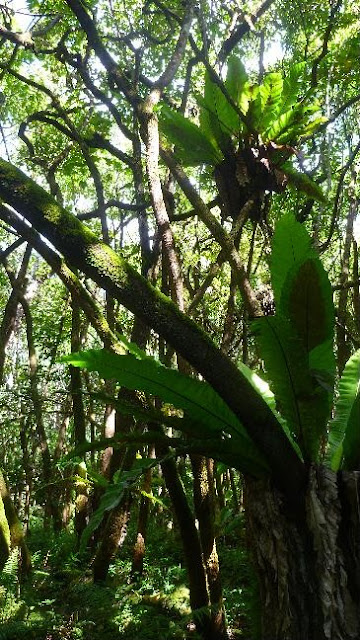
At the top of this Hala there is a Bird's Nest Fern splaying itself out and catching the shadows of the hala leaves above.

> > > > > > > > > >
The fecundity of Hawai'i is on display throughout the forests, oceans and orchards. Between fruits, seeds, roots, urchins, flowers and fish, sex is everywhere. Take the hala root, one of the most falic items of the forest, it has a head at the growing end of it's shaft which plunges into the earth for stability and nourishment. Unfortunately, I don't yet have any photos up of our very "feminine" aspects of nature.
 < < < < < < Waiwi (VY-VEE) or Strawbery guava is another invasive that is over-abundant in Hawaiian forests, although the wood is a tremendous resources.
> > > > > > > > > > > > >
Bird's Nests ferns perch themselves in the most scenic places throughout the forest. Although, to be true to their names, they would have to house pterodactyls to really utilize their immense size. The larger ones could easily fit a few people sitting cross-legged.

< < < Closer-up Bird's Nest fern

One of my favorite things about the abundance of ferns here, is the strange lovelyness that is their means of reproduction. The spores of ferns vary in size, color and location.


> > > > > > > > >
Kupukupu fern and spores
(COO-POO-COO-POO)


 Large "shaggy-barked" O'hia tree mingling with the arms of Hala trees under a vast canopy of Hala leaves. > >
 **BLUSH** Inter-species ferning > >
^ ^ ^ ^ ^ ^ ^ ^ ^ ^ ^ ^
African violets litter the forest and the sides of our dirt roads. Amazing how many continents have made their impression on this little island so far from the rest of the world.
THE HALA STORY....


> > > > > > > > > > > > > > > > > > > > > >
Hala leaves or lauhala (L-OW-HA-LA) were traditionally used for making tapa cloth. They fall of the trees and dry on the floor below. They are made of an incredibly sturdy, waterproof material. But CAREFUL! they have thorns on their edges that'll GETCHA.

At the top of this Hala there is a Bird's Nest Fern splaying itself out and catching the shadows of the hala leaves above.

> > > > > > > > > >
The fecundity of Hawai'i is on display throughout the forests, oceans and orchards. Between fruits, seeds, roots, urchins, flowers and fish, sex is everywhere. Take the hala root, one of the most falic items of the forest, it has a head at the growing end of it's shaft which plunges into the earth for stability and nourishment. Unfortunately, I don't yet have any photos up of our very "feminine" aspects of nature.
 < < < < < < Waiwi (VY-VEE) or Strawbery guava is another invasive that is over-abundant in Hawaiian forests, although the wood is a tremendous resources.
> > > > > > > > > > > > >
Bird's Nests ferns perch themselves in the most scenic places throughout the forest. Although, to be true to their names, they would have to house pterodactyls to really utilize their immense size. The larger ones could easily fit a few people sitting cross-legged.

< < < Closer-up Bird's Nest fern

^ ^ ^ ^ ^ ^ ^ ^
This is the underside of a Bird's Nest fern, where is keeps it's spores.
One of my favorite things about the abundance of ferns here, is the strange lovelyness that is their means of reproduction. The spores of ferns vary in size, color and location.

< < < < < < < < <
This is one of my favorite photos of the Lawae fern spores (pronounced LA-VA-A).

> > > > > > > > >
Kupukupu fern and spores
(COO-POO-COO-POO)

^ ^ ^ ^ ^ ^ ^ ^
Mr & Mrs CrazyMossHair
can you see them?

< < < <
LOVELILY
.DA END.

